
DREW HERNANDEZ' MARKETING PORTFOLIO


INTEGRATED CAMPAIGNS
LUNCH BREAK
INTEGRATED CAMPAIGNS
(1/2)
OVERVIEW
PayCompass goes to four big trade shows every year: NEAA, SEAA, WSAA, but the biggest one by far is MWAA. It’s in downtown Chicago, with thousands of attendees.
So, for MWAA 2026, we designed our own cologne, and worked with a local perfumery, Lotions & Potions, to get the scent just right. Calabrian bergamot and pink pepper, ambroxan and dark amber. This scent needed to represent the freedom of selling 150+ solutions with PayCompass, the freedom of lifetime residuals, but more importantly, the freedom of taking your lunch however - whenever - you want. Lunch Break, the official scent for 1099 Sales Agents, was born.
_JPG.jpg)
After a few rounds of revision, we found our cologne, and ordered a gallon of eau de parfum to fill fifty 50mL bottles and five-hundred 2mL samples.
We’d use the 50mL bottles as corporate gifts for our best Sales Agents and for our biggest partners. One-hundred fifty of the 2mL samples would be given out as swag at MWAA, and the remaining three-hundred samples would be mailed to all active PayCompass Sales Agents after the campaign’s conclusion. One of the 50mL bottles would be used in an Instagram giveaway.
Now that we had the scent down, it was time to create the story. I formed a writing duo with our Assistant Director, and, together, we created the campaign; Lunch Break would play into the open possibilities of the American Southwest without getting too muddled in Western pastiche (so no cow skulls, or wanted signs, or horses). We focused on the sunset, the open flame under a jet-black sky, the cloud of dirt - the flashes of untamed wilderness that only last a few moments.
After a few rounds of revision, we found our cologne, and ordered a gallon of eau de parfum to fill fifty 50mL bottles and five-hundred 2mL samples.
We’d use the 50mL bottles as corporate gifts for our best Sales Agents and for our biggest partners. One-hundred fifty of the 2mL samples would be given out as swag at MWAA, and the remaining three-hundred samples would be mailed to all active PayCompass Sales Agents after the campaign’s conclusion. One of the 50mL bottles would be used in an Instagram giveaway.
Now that we had the scent down, it was time to create the story. I formed a writing duo with our Assistant Director, and, together, we created the campaign; Lunch Break would play into the open possibilities of the American Southwest without getting too muddled in Western pastiche (so no cow skulls, or wanted signs, or horses). We focused on the sunset, the open flame under a jet-black sky, the cloud of dirt - the flashes of untamed wilderness that only last a few moments.

For the bottle design, we went with a cream-dominated label on a boxy glass bottle to keep things simple, elegant. The jumbled silhouette of a desert landscape crawled across the bottom of both the bottle and its box, the latter bearing a lone Harris’s hawk on the top flap.
Tyler Riviera was our fictional Leisure Ambassador created for the campaign, and we cast Drew Hernandez (AKA me) to play the part. I worked with Retro Ranch to piece together his outfit (which, coincidentally, was across the street from our perfumery).
Tyler needed to look like the personification of our cologne, because Tyler was going to walk the trade show floor at MWAA, so Tyler was covered in a bundle of silver-and-turquoise necklaces, and chunky metal rings, and an all black sheer top, gnarled belt, cowboy hat, cowboy boots, and pants. A dark blue vest finished that elevated Western look.
There were a lot of assets to capture, so we slated two days full days at a local photography studio to capture what we needed. The first day was focused on product photography of the bottle itself, which we shot against a sunset backdrop and rested on desert dirt and rock, and still lifestyle photography of Tyler Riviera.
The second day was videography with Tyler. We bought vegetarian Chicago dogs from Portillo’s and used a strobe setting on the studio lighting to simulate the paparazzi capturing Tyler’s first bite. The dog was shot alone on a black velvet table and covered with steady puffs from a smoke machine.
Using a black backdrop, dim lighting, and some manual flickering, we were able to successfully mimic the lighting of a campfire on Tyler’s face. We used a marbled background to film Tyler speaking to the camera for a few different videos, and wrapped up the day by shooting on-location at South Mountain.
All of this videography and photography was shared with the rest of the squad, and, under my direction, we created the assets for the big campaign.
Emails were blasted to the MWAA attendee list and to our Sales Agents.

The first email teased the cologne, and, after a shadowy video introduced Tyler on our socials, we introduced Lunch Break to the world with the commercial that we’d shot on-location.
The second email announced that Lunch Break was going to MWAA, which paired with the MWAA campfire announcement video on our socials. The third email highlighted the scent notes and was sent a week before the trade show.
In between, there were two carousels of faux print adverts, a looping stinger reel, a giveaway post, and a stylized video that announced the attendees of MWAA (with a cameo from Tyler at the end).
On the first day of the trade show, we sent the fourth email: a countdown clock for MWAA’s opening remarks. Attendees who came to the Grand Ballroom at 2:45pm that day were shown the paparazzi video where Tyler waxed poetic about the ingredients of a Chicago dog, and, then, Tyler appeared on stage to re-introduce Lunch Break to a captive audience.
From there, Tyler walked the trade show floor and brought attendees back to the PayCompass booth for a 2mL sample of Lunch Break, which were laid out next to an uplit transparent case containing a pristine 50mL bottle. A custom video of Tyler and Lunch Break looped on a nearby TV.
When MWAA was finished, Tyler hung up his hat, and, once the remaining 2mL samples were mailed to non-attending Agents, the campaign officially ended.
RESULTS
Leading up to the trade show, our emails averaged a 56% open rate and an 18% click-through rate - a 36% increase in pre-show email engagement compared to MWAA 2025. The Lunch Break giveaway had over 100 entrants, which earned that post one of the highest comment counts of any social post.
On LinkedIn, our highest-converting social platform, the Lunch Break campaign generated a 26.5% increase in reactions, a 230.4% increase in comments, and a 100% increase in reposts.
At MWAA, we were swarmed for samples and nearly ran out during the first open session - and, the cherry on top: we won “best swag” at MWAA.
As a direct result of Tyler bringing people to the booth for a sample of Lunch Break, three new Agents were signed to PayCompass. That’s huge, because a single Agent can generate hundreds of thousands of dollars in annual revenue through credit card processing fees.
But, the most important metric of all: people said that Lunch Break “actually smelled good.”
VALLEY HEAT
INTEGRATED CAMPAIGNS
(2/2)
OVERVIEW
Genie is the official mobile app for PayCompass Sales Agents, available for direct download from their respective Regional Sales Director. The whole thing was developed in-house for two big reasons: (1) to give Agents access to our 150+ solutions while selling in the field, and (2) to allow Agents to instantly, accurately estimate how much a prospect merchant could save through cash discounting, interchange plus pricing, and surcharging.
Genie’s a useful tool for any Agent, and we needed to spread the word; I formed a writing duo with our Assistant Director, and, together, we created a 80’s-style TV show called Valley Heat, starring two buddy cops who used Genie to crack every case.

Their names: Dominic Rourke (played by our President, Rob Johnson) and Roman Vega (played by our Chief Operating Officer, Chris Torres). Both of them got a thick wig and a pastel two-piece suit.
We spent a day shooting photography for print, social, and email assets in a local studio. Dominic and Roman got fake magnums to aim in a Genie-blue convertible, which we shot (with a camera) for a few different social videos. The next day, we captured additional footage with our stars around our office park, which we turned into videos for LinkedIn and GIFs for email.
But, when it came time to roll things out, instead of Valley Heat serving as the campaign’s main driver, I positioned Genie as a high-paying sponsor of the show; the product placement was played up to a comical degree.
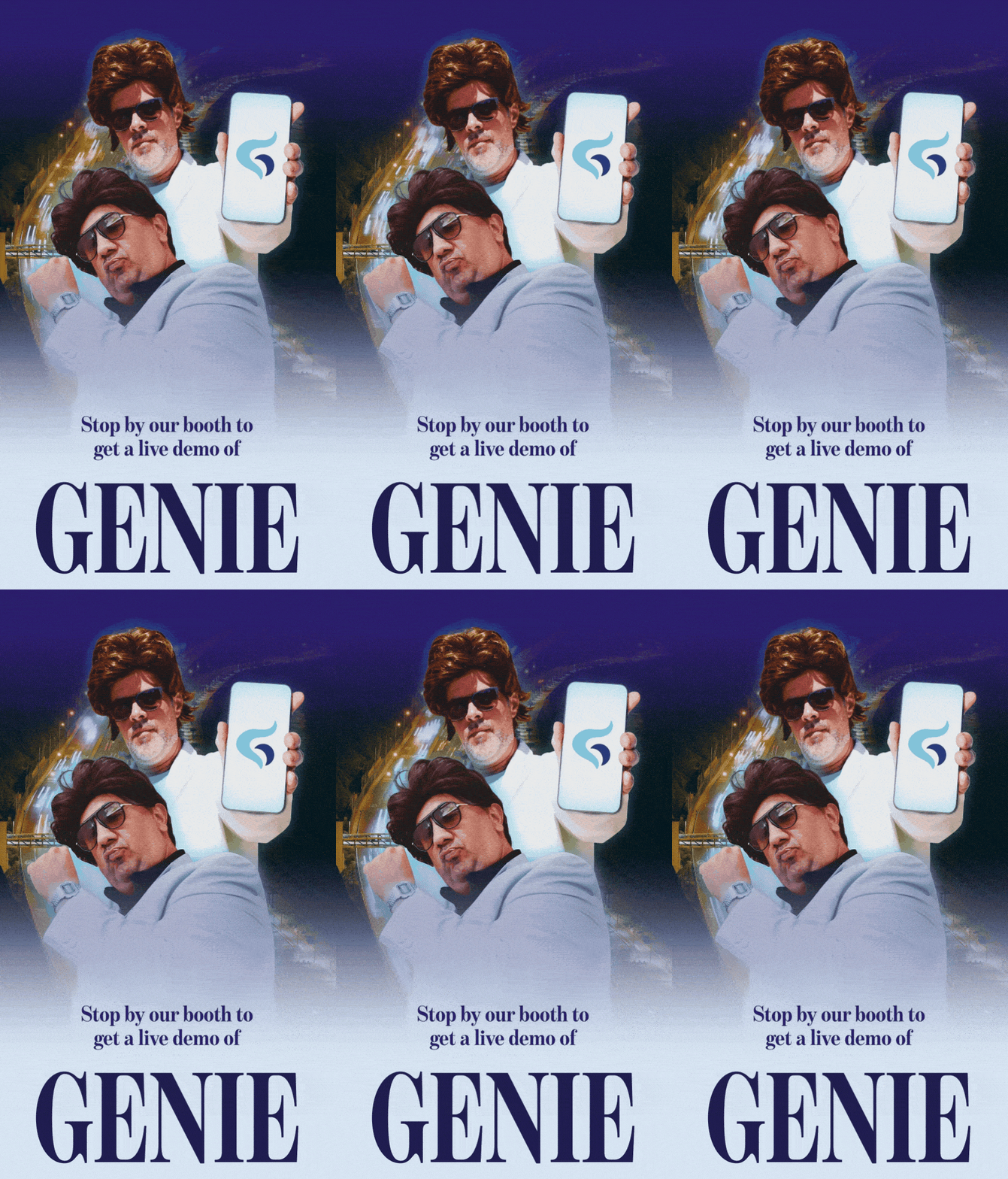
“Dominic and Roman use Genie in Valley Heat.”
That phrase colored every neon-soaked alley of the campaign, including a custom Spotify playlist of the OST, a “contractually-obligated” thank-you video from the cast of Valley Heat, and a capstone physical pop-up at an industry trade show in Florida.
After getting a steady drip of emails espousing Genie, attendees of SEAA 2026 would find a cardboard cutout of the stars, t-shirts with Dominic and Roman’s iconic faces, and custom Valley Heat cassette tapes that doubled as business cards. What’s on the tapes? I’m not telling!


RESULTS
When the campaign had concluded, 94% of all PayCompass Agents had started using the Genie app. 52% used it at least three times a week, and our whales (17% of Agents) used the app daily with an average time on the app above five minutes per day.
On LinkedIn, our highest-converting social platform, the Valley Heat campaign generated a 25.9% increase in impressions, a 72.2% increase in reactions, and a 335.7% increase in comments.
Compared to SEAA 2025, there was a 34% increase in overall social engagement with Valley Heat campaign assets. Emails averaged 53% open rates and a 12% click-through rate.
After SEAA 2026, the majority of high-value prospects received a cassette tape business card. Those that converted to PayCompass Agents would earn the company $25,000+ in the three months following.
GO -TO-MARKET STRATEGY
SURETECH
GO-TO-MARKET STRATEGY
(1/3)
OVERVIEW
Developed in house by the PayCompass support and logistics teams, SureTech is a monthly protection plan that gives business owners a lifetime warranty for their payment equipment, with free hardware replacements and 365-day support offered by our headquarters in Tempe, AZ.
SureTech pricing would be available for all PayCompass Sales Agents to pitch their merchants.
I oversaw the go-to-market strategy and provided creative direction for all phases of the SureTech launch.


The campaign slogan “Protection Feels Good” played into the tongue-in-cheek humor of the PayCompass brand voice; the floating terminals, metallic glints, inky-black voids, and microchip-esque pipes tied the physical nature of POS systems to the “hardware-as-a-service” support offered by SureTech.
This multi-channel project included a custom landing page, recruiting pitch deck, an automated onboarding email, a social media announcement video, and merchant-facing flyers.
RESULTS
Within the first 60 days, 16% of eligible existing merchant accounts added SureTech to their monthly statement. 71 SureTech opportunities with prospect merchants were opened by PayCompass sales Agents who engaged with SureTech launch materials (including the flyers and custom landing page).
Compared to Sales Agents who did not use the SureTech printed flyers, those who did saw a 3% increase in SureTech sign-ups.
After the first 60 days, there were 106 enrollments in the SureTech program, with the created SureTech materials influencing $3,500+ in recurring monthly revenue.
ANKER
GO-TO-MARKET STRATEGY
(2/3)
OVERVIEW
Headphones, speakers, and power banks. That’s Anker, one of the leading tech brands on Amazon - and, thanks to an exclusive partnership with Zing Manufacturing, Anker would be making their grand debut in the promotional products industry.
Since Zing Manufacturing was a supplier of promotional products, the goal of this product launch was to inform new and existing distributors about the Anker tech now available on our online storefront, and to share which products were coming soon.
I oversaw all marketing aspects of the Anker product launch. Working with the Anker team in Changsha, Hunan, China, I obtained the necessary product imagery and descriptions for Zing’s product pages. The images were given to my graphic designer to schmear logos onto (that’s the promotional product industry!) while I expanded on the copy.
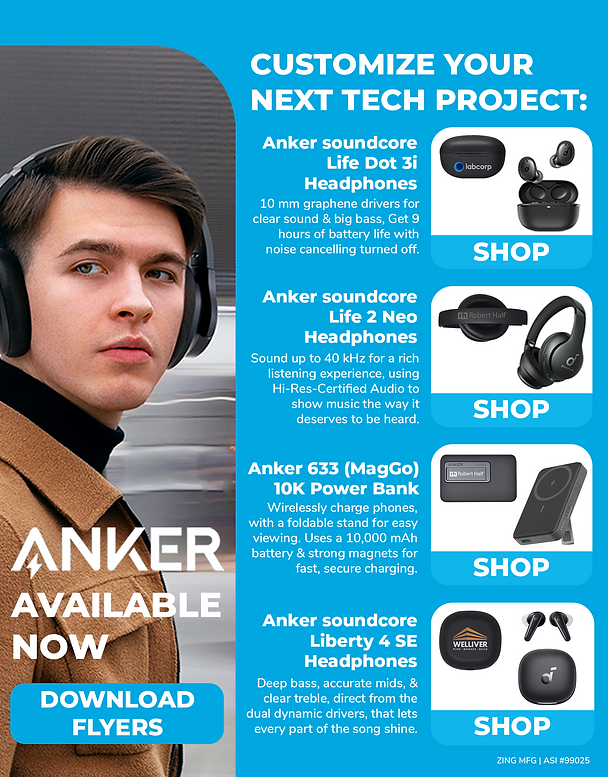
A large chunk of my efforts surrounded our Regional Sales Directors (RSD), who I collaborated with to create Anker-facing copy and collateral for their books of business. The RSDs were the biggest marketing channel we had, so they needed big support to drive big Anker sales.
But the cornerstone of the Anker product launch was the Anker webinar. I wrote the webinar copy, organized the slides, delegated which RSD would speak to which section, ran virtual run-throughs; I bought digital ad space in ESP (the Amazon for promotional products) to hype the event; I shot targeted email blasts at our distributors.
The second that webinar ended, the Anker products would go live.


RESULTS
The Anker product launch webinar was attended by 200+ distributors in the promotional products industry. Within the first 30 days, the webinar influenced ~$20,000 in Anker sales, including from five accounts that were, at the time of attending, prospects.
Within 30 days, general post-webinar lookbook requests rose by 23%.
SQUARE
GO-TO-MARKET STRATEGY
(3/3)
OVERVIEW
If you’ve eaten at a local restaurant or visited a retail shop, then you’ve heard of Square. It’s Block Inc’s response to a slow-to-change payments industry, with hassle-free onboarding and same-day batching.
And, thanks to an exclusive partnership with PayCompass, Square was available for our Sales Agents to sell across the US.
I oversaw all marketing aspects of the Square partnership launch and, with great responsibility, fulfilled my destiny as my team’s certified Square freak.
When it was time to go live with our exclusive partnership, we had an announcement video that, in line with our other non-serious content, was a cooking show that only made Square foods. I worked with Square to create co-branded flyers for our Sales Agents to use in the field; a general email was drafted, to be followed by more in-depth emails sent on behalf of our Regional Sales Directors.
Working with our training department, “Square Bootcamp” was born: a limited-run webinar series exclusive to PayCompass Sales Agents that covered a different standout feature of Square. Every Thursday, 10 AM PT / 1 PM ET.


RESULTS
82% of active Agents engaged with at least one partnership launch resource.
Out of the Agents presented with our proprietary Square content bundle, 26% downloaded Square collateral to use on their prospect businesses or enrolled in Square Bootcamp. Compared to those who did not download Square collateral or enroll in Square Bootcamp, those that did saw an Square sales increase of 58%.
Within three months of launch, PayCompass became one of the top five square resellers in the country.
TEAM DEVELOPMENT
SCRUM
TEAM DEVELOPMENT
(1/2)
OVERVIEW
The Agile Framework has been largely reserved for tech teams, where developers work in two-week Sprints to complete cards with shippable final products.
Why not use it in marketing?
When I joined PayCompass, we had been 10+ Asana boards to organize individual projects. My first priority was consolidating everything into one centralized Marketing Backlog, where all ideas were banked and ranked from “Unprioritized” to “To-Do.”
I then created a brand-new project management structure for my team, loosely based on Scrum. We had a Daily Stand-Up where team members shared intentions and impediments, and a Weekly Planning Meeting where Marketing Product Owners shared what their team intended to tackle in the upcoming week.
Most importantly, no matter what their position was, all team members were encouraged to place their projects in the Marketing Backlog’s “Inbox” column, with applicable context for the product owners to review during the Weekly Planning Meeting. This allowed all team members to have a voice, and it’s what ultimately shifted my team from a more traditional top-down management structure to a more efficient self-governed management structure.
RESULTS
Compared to the previous six months, this new management style saw an increase of 68% in total projects completed.
Less tangibly, this structure reduced last-minute requests significantly because Marketing now had a clearly visible workload; any request that another department deemed “high priority” was met with appropriate communication on which projects would need to be deprioritized to make space for that new project.
This kept my team from working after hours and prevented burnout from constant shifting priorities. As a manager, my number one goal was fostering an ecosystem that gave my direct reports time to get dreamy and create something beyond the ordinary; if you’re structured in your daily life, then you can get unstructured in your creativity.
ONE-ON-ONES
TEAM DEVELOPMENT
(2/2)
OVERVIEW
Now that I’d created a project management structure at PayCompass, it was time to build professional development opportunities for my direct reports.
This started with recurring weekly one-on-one meetings every Monday, which recapped the Weekly Planning Meeting that had just occurred that Friday prior.
These one-on-ones followed a predictable cadence:
• What’s one incredible thing you did last week?
• Did you engage in any cross-team collaboration?
• How can the marketing team improve the way we work together?
• What new projects do you have questions on?
• What projects do you intend to take on next week?
• What additional priority shifts would you recommend for the backlog?
We’d also plan what they intended to tackle during their 30 minutes of concerted weekly professional development; the skills learned during those exercises feed directly into the quality of every final product delivered.
At the end of the meeting, I’d have a list of the projects they intended to work on the following week, which I’d bring to the Weekly Planning Meeting on their behalf.
RESULTS
Since starting these one-on-ones, all direct reports earned promotions or expanded their responsibilities within 14 months.
Over that time frame, all direct reports maintained an average of 90%+ in the completion rate of their weekly assigned projects. All direct reports accomplished an average of 90%+ of their quarterly professional development goals.
LOYALTY
ONBOARDING
LOYALTY
(1/3)
OVERVIEW
New members at the Chandler Chamber of Commerce came in four categories: (1) Entrepreneur, (2) Business, (3) Corporate, and (4) Presidential. The price and membership perks increased accordingly.
From my research, the most physically active members were those in the Startup and Business membership tiers. They attended the most events and were the ones most likely to engage with our marketing materials.
However, while Corporate and Presidential members were less frequent attendees or sources of social media engagement, they provided the majority of funds for our programming (most visibly as sponsors for our events, like Economic Updates or Education & Workforce seminars).
So, if you needed to create an onboarding sequence for these four groups, you’d need to essentially create four different onboarding sequences… which is exactly what I did.
Entrepreneur-level members were given practical tips to start a business. Business-level members were told about networking events. Corporate-level members were told about the Chamber’s political impact. Presidential-level members were given a special message from our President & CEO, Terri Kimble.
All members received a form to “finish their business profile.”
But what was more important than the emails themselves was the impact on the Business Development team. Since the Chandler Chamber’s inception in 1912, there have never been any formalized internal reminders for following up with businesses. In this onboarding sequence, a series of internal notifications were created, specified for each business’ needs and form responses, that were sent to Business Development Area Managers over the critical first 90 days.
RESULTS
Averaged across membership tiers, external onboarding emails received a 75% open rate and a 54% click rate. 91% of contacts who received onboarding emails opened all emails in the sequence.
Compared to the previous six months, there was a 104% increase in people who completed their business profile after receiving the onboarding emails.
Compared to the previous six months when Business Development Area Managers did not receive new member follow-up reminders, total recorded touches during new members’ first 90 days increased by 97% during the six months after the email sequence was launched.
AUTO-KITS
LOYALTY
(2/3)
OVERVIEW
TheraSpecs are therapeutic blue light glasses for people with light sensitivity, so we built relationships with medical providers to get our product in front of the right folks. Every provider got (1) a free pair of TheraSpecs and (2) a stack of info cards with a hand-stickered coupon code, good for $10 off a patient’s purchase; these codes were different for each office (“DRJOHN10,” for example).
While these coupon codes allowed us to track which providers were the most successful referral sources, there was a pretty chunky bottleneck: providers handed those cards out to patients, and, once the provider was out of cards, it was up to the doctor to contact us and ask for more.
Now, doctors are incredible at their job, but medical school doesn’t prepare you for the business side of running a business. These folks are helping people live better lives, so the last thing on their mind is calling TheraSpecs for more paper brochures. But no referral codes means no tracking, lost sales, faded relationships - ah!
So, with IT to execute, I invented a new system. First, an internal reminder would be sent seven weeks after the last info kit refill order was fulfilled, prompting us to contact the provider’s office to confirm whether or not that provider needed more info cards.
Whatever the provider responded, the internal team member would add the tag “Card Reorder Override” to delay the auto-fulfillment process and allow for a manual override. Special cases had a permanent tag: “Always Manual Cards.”
However, if the provider did not respond, then a new order was automatically created in BigCommerce, with a prepaid shipping label ready to fulfillment.
An automated email confirming the order was sent to the provider’s email on file.
I also improved the coupon code application process so that, instead of keying in the coupon codes (which was ripe for user error), there was now a provider lookup feature that printed 50 coupon stickers with the click of a mouse.
RESULTS
During the first three months of implementing this new system, there was a 46% increase in coupon code fulfillment across all providers, generating $8,000+ in additional gross revenue.
Before the process was improved, providers received an automated “need a refill?” email six weeks after their info cards were shipped, which would allow providers to manually request an info kit refill. This email was kept in the new system, and, with many providers receiving unprompted info cards at the start of this new program, the next cohort saw a 79% increase in completion of the manual info card request form.
HOLIDAY FUN
LOYALTY
(3/3)
OVERVIEW
For TheraSpecs customers, our glasses were a wish in a box. Blocked irritating blue light from hitting their eyeballs and reduced uncomfortable symptoms brought on by light sensitivity.
Folks learned about TheraSpecs through Reddit threads, and word-of-mouth, and our blog articles, but medical providers like physical therapists and occupational therapists were one of the more unlikely channels that drove a decent chunk of revenue.
Our Black Friday sale was coming up. Biggest sale of the year. To add a dash of surprise and delight, I designed a limited-edition holiday box, got it printed, and tucked each pair of TheraSpecs with one of those melt-in-your-mouth peppermint balls. Made the whole box smell like Christmas - a literal wish in a box.
For those providers who gave trial pairs of TheraSpecs to their patients, I designed a holiday card and had them mailed to every practice on our list. The back would retell the story of why we made TheraSpecs in the first place, and the front would be just too cute to throw away.
RESULTS
The boxes lasted from our Black Friday sale through the latter half of January. During that time, our NPS score went up by one point, with four promoter-level reviews specifically mentioning the holiday packaging.
Compared to the 60 days prior, providers who received holiday cards responded with a 14% increase in requests for TheraSpecs samples and informational brochures.
The previous year, providers did not receive a holiday card. Comparing Januaries, in the year that providers received holiday cards, there was a 57% increase in inbound contacts from established providers and an additional $3,000+ in gross revenue from established providers.
EVENTS
OSTRICH FESTIVAL
EVENTS
(1/3)
OVERVIEW
It’s the third largest outdoor festival in Arizona, and the only one that featured ostrich racing.
That’s right, the Chandler Chamber Ostrich Festival used to have gladiator chariots yanked around a dirt track by really big birds. The races were quietly discontinued a few years ago, but, if you’ll pardon the metaphor, there were other ostrich races still taking place at the festival that I, as the sole full-time marketing employee of the Chandler Chamber, helped change for the better.
For a while, guests interested in attending the Ostrich Festival had no official web page to learn what pricing options were available for families, or Chandler residents - only a Tixr “buy now” link that was a glorified checkout page. I worked with our event production team to build a separate page, ostrichfestival.com/tickets, which gave guests a much-needed preview before committing to a purchase.

Ozzie the Ostrich was the festival’s mascot. We dusted off a big goofy suit every year to walk around the fairgrounds, but I felt that a character so visually distinct needed more appearances in the “real world” to build the hype. Working with our event production team, I got Ozzie in Chandler elementary schools to target local kids, and on local TV to target families. If you found Ozzie walking around Bashas, then you’d get free tickets to the Ostrich Festival.

I reviewed all press releases before they were published by our news partners, which included The Arizona Republic, AZ Family, and VisitPhoenix. Press releases largely focused on new and returning attractions, headlining acts, and general festival information like parking and clear bag policies.
Within the Chandler Chamber, I created targeted Ostrich Festival sponsorship request emails, which were sent to the membership tiers most likely to pay for in-park advertising; I provided a festival sponsorship call track for our Business Development team to follow-up with members over the phone.
I directed our event photographer/videographer to capture specific assets on the fairgrounds, which could be used to promote future Ostrich Festivals.
During the event, I coordinated media hits with our event team, including FOX10 and AZ Family. When it rained during the Friday night headliners, Roger Clyne & the Peacemakers, I led the charge to get discounted tickets to everyone who came that night.
I remained available for any general support over the Ostrich Festival’s two-weekend run. As a Disneyland aficionado, running a tiny amusement park’s a dream come true.

RESULTS
The Ostrich Festival was attended by 150,000+ Arizona residents and generated a $9+ million economic impact for the Chandler Chamber.
$55,000+ was generated from web visitors who started at the “Tickets” page before proceeding to the “Buy now” page.
The targeted sponsorship emails influenced $7,000+ in Ostrich Festival sponsorships from Chandler Chamber members.
From the Friday guests who received a discounted return ticket due to rain: compared to standard attendees, the Friday cohort saw a 39% increase in guests who visited at least one more time during the festival’s two-weekend run.
More importantly, there were 27 ostriches, which, compared to the previous year, was a 3.8% increase in total birds attending.
PROVIDER WEBINAR
EVENTS
(2/3)
OVERVIEW
In order to spread the good word about TheraSpecs’ medical-grade blue light glasses, you need strong relationships with medical providers, like optometrists and occupational therapists.
We traditionally found new providers by exhibiting at trade shows across the US, like ANPT-ICVR in Minneapolis, MN. One of the attendees I met there worked for the Children’s Hospital Colorado.

After the show, when that attendee submitted a request for a free pair of kid-sized TheraSpecs, I noticed they listed that they work with 30-40 colleagues… and my spidey sense started tingling. See, we had an hour-long presentation from a local in-service; this was the perfect opportunity to turn it into a 10-minute deck and spread TheraSpecs across an out-of-state, multi-provider organization.
I asked my contact at Children’s Colorado if she’d be interested in a quick overview of TheraSpecs for her and her colleagues, and she very excitedly agreed. That’s the benefit of having a product that uses real science to reduce light sensitivity: if it helps the patients, then it basically recommends itself.
Soon as that presentation was finished, I delivered it to a room of virtual smiling faces.
RESULTS
From that single webinar, one initial trade show contact yielded 13 active provider referral sources. Each provider received a sample pair of TheraSpecs and informational cards to share with parents, with a unique coupon code for tracking success (“DRJOHN10,” for example).
Within five months, these providers had generated $6,000+ in directly attributable gross revenue, with an estimated total revenue closer to $9,000+ from parents who ordered without the trackable coupon code.
CHANDLER 100
EVENTS
(3/3)
OVERVIEW
If you’re looking to get your Presidential-level members all in one room, ones who typically don’t attend your regular programming, then you host a gala like Chandler 100.
The Chandler Chamber ranked the city’s top 100 companies by total number of employees, and invited the executives of those top 100 companies to a non-traditional venue (like a helicopter hangar) for a black-tie networking event, catered by Chandler’s hottest restaurants.
But, if you peeked behind the handshakes and martinis, you’d find an event without a clear visual direction - an event whose direction changed year after year. Chandler 100 was one of the most physical ways that the Chandler Chamber solidified itself as a leader in the East Valley, so creating a brand identity was crucial to continue positioning ourselves as a partner worthy of investment.
Working with my graphic designer, we created a new identity for Chandler 100 that could be built upon for years to come.

Chandler Chamber of Commerce. Three “C’s.” Bend them a bit, and you get circles, ones that represent the interconnected nature of business. Slice those circles into little chunks, and you get windows into how each business operates. Interlock those circles, and bang - those are the zeroes of the “100” in “Chandler 100.” Spin them around in motion graphics, or have them peeking off the edge of a page.
The Chamber uses three main colors: purple, green, blue. Out of that selection, green’s the most relevant to the high-tech businesses like Microchip and Intel that stack the Chandler 100 list. Bake the blue into a deeper, almost black color, to make that green really stand out.
Theme the tables to match. Get glass centerpieces with deep-green water crystals, and put a holographic centerpiece on the tables reserved for Chandler 100’s big three sponsors.

To set the mood during cocktail hour, I created a looping video that played on flanking LED walls.
Once all our guests were seated, and after our President/CEO had given opening remarks, we played another video I created that acted as a year-in review of the Chamber’s efforts. The footage combined shots I’d taken throughout the year and footage donated by Chandler 100 members. The statistics were collected throughout the year, like how the Chamber directly monitored 1,798 bills during Arizona’s legislative session, and how 4,707 people attended our monthly networking events.
But the biggest nut to crack was a printed book that acted almost like a directory for these businesses. Working with our graphic designer, we created a sleek, reusable template that could be used for future Chandler 100 events, something that could act as a high-quality leave-behind and a reason for our Business Development team to visit non-attendees in-person.


RESULTS
Chandler 100 was attended by 500+ members of the top 100 largest employers in the State of Arizona. 93% of those attendees took at least two copies of the Chandler 100 book.
When it was time for Executive- and Presidential-level members to renew their existing sponsorships, businesses who attended Chandler 100 were 50%+ more likely to continue supporting the Chamber, with 12% of those businesses expanding their sponsorships.
The Business Development team leveraged the printed book to secure in-person appointments with 69% of the Chandler 100 businesses not in attendance.
With the new brand identity, future Chandler 100 assets could be created in a significantly shorter time, allowing for greater attention to detail on additional scalable event improvements.
BRANDING
CHANDLER CHAMBER
BRANDING
(1/1)
OVERVIEW
While many other chambers of commerce, like the Gilbert Chamber, are subsidiaries of their respective cities, the Chandler Chamber was incorporated before the City of Chandler was officially recognized by the State of Arizona. The Chandler Chamber’s remained independent since, which means that it has full control over how it visually represents itself.
But, before I joined, the extent of the brand guide was a logo, a typeface, and a series of color swatches - all on a single-page PDF. The Chamber was big on hosting events, from recurring series like Women In Leadership, to signature events like the Education Forum, so to create a stronger sense of identity through a standardized visual language would only strengthen the view that the Chandler Chamber was a powerful non-profit with a clear, dedicated focus.

I started by updating the hues of our purple, green, and blue for higher contrast on white text. To communicate a modern Chamber that was playful enough for the startups but serious enough for enterprise members, both the header and body typefaces became the sans-serif Neue Haas Grotesk.
The logo was subtly updated. The thin dividing line between the logomark and wordmark were removed, the gradients were removed, and the logomark and wordmark were resized for a better match.
To best showcase the changes made to the brand, I’ll spotlight the website, which was prescriptive of the Chandler Chamber at large. For lack of better terms, the website was a journal written in pen by 19 different authors. Pages stacked on top of each other, without deeper intent, without deletion. Some pages shared the same stagnant template with text that spread across the entire screen, and others relied heavily on scroll-induced animations.


I was positioning the Chamber as the literal representation of East Valley businesses, so a single unified aesthetic had greater implications than making things look cool.
I started by auditing the current pages for which could be kept, combined, or deleted. This informed which pages needed to be created, which included a page for all committees, a page for each policy pillar outlined in our annual legislative document, a “why join” page with public membership pricing, and a page for the bills we were currently tracking.
After those pages had been outlined, it was time to fix the existing site. First came a universal template page with a suite of pre-saved modules. New header menu, new footer menu, and new versions of tentpole pages (e.g. “Home,” “About Us”).
Once everything was ready, all changes were published, and the new site went live.


RESULTS
The following results compare the one year prior to my arrival at the Chandler Chamber to one year after. The website refresh was completed about eight months into my tenure.
Across the website, there was a 137% increase in overall views, including a 156% increase in home page views. Overall web traffic was grown by 117%.
There was a 222% increase in visits to our event calendar. Events were one of the main ways our organization made money, so this was a glowing stat that aligned with an overall increase in event attendance.
In one year, there was a 5,903% increase in sessions started by email, which I attribute to my targeted emails and monthly newsletters that hit specific members, rather than blasting the same message to all contacts.
CUSTOMER CONVERSION
US VS THEM
CUSTOMER CONVERSION
(1/4)
OVERVIEW
The payments industry is full of companies that take total advantage of their Sales Agents, so, to explain the PayCompass difference, I created a digital white paper for my pals in Recruiting to share with their prospects.
Bad companies were positioned as bad significant others, and PayCompass was the friend that was giving them the straight talk about how things really don’t need to be like this - that there’s a better match out there.


Like lifetime residuals with a survivorship clause, or Agent-prioritized underwriting. Or how PayCompass is one of the only authorized Square resellers in the nation, with a mobile app we developed in-house exclusively for PayCompass Agents.
There was another “Us V Them” white paper variant for prospect Agents who were salaried W-2 employees. This one focused on the huge earning potential that salaried Agents are leaving on the table, and backed it up with testimonials from PayCompass Agents who had taken the leap to 1099 and seen huge success.
Because, when an Agent’s feeling mucky, they need a friendly face to prove that it’s not them: it’s their ISO, and that experiencing #AgentFirst is closer than they think.


RESULTS
In the first 3 months after the debut of the “Us V Them” white paper, prospect Agents who received the “Us V Them” white paper were 15% more likely to progress to the next stage of the recruitment process.
Comparing to the prospect conversion rate of the prior five months, overall conversions increased by 3%.
PITCH DECK
CUSTOMER CONVERSION
(2/4)
OVERVIEW
When chatting with prospect Agents, the PayCompass Recruiting team could only rely on their blinding charisma and curated screenshots of our website to charm folks into signing a contract. There weren’t any branded presentations for my friends to riff off, so I partnered with Recruiting to create four variants of a “Why PayCompass?” pitch deck.
The first version was a persuasive deck targeting people who were on the fence, and it was the longest deck by far. Agent testimonials, earnings breakdowns, The AgentFirst Podcast - all the PayCompass bells and whistles.


The “ready to join” deck was for warm leads, which was a modified informative version of “on the fence.”
The next deck was for prospects who Recruiting had identified as busy, but interested. It was the shortest version of the four, a truncated version of “ready to join.”
The final deck was a unique presentation for salespeople who currently worked W-2 but wanted to hear out why 1099 could be a good fit.
Now that the four decks were complete, it was time for recruiting to take them for a joy ride.


RESULTS
Comparing the five months prior, there was a 20% increase in prospect Agents who moved from the pitch call to a follow-up call.
There was a 5% increase in prospects who were convinced to join PayCompass during the pitch call.
With a pitch deck to reference, Agents were requesting more information on specific topics, which inspired dedicated one-pagers on solutions like Square, or our Genie app. This was novel, but prospects who requested more information during the pitch call were more likely to become PayCompass Agents.
NURTURE CAMPAIGN
CUSTOMER CONVERSION
(3/4)
OVERVIEW
When a prospect Sales Agent doesn’t end up joining PayCompass, they usually fall into four buckets: (1) the Agent ghosted us during any phase of the recruiting process, (2) the Agent didn’t have enough experience selling payment processing, (3) the Agent declined our offer and continued to work as a 1099 employee somewhere else, or (4) the Agent declined our offer and continued to work as a W-2 employee somewhere else.
And that was that. For a while, if a prospect never worked for us, we never spoke with them again. I thought that was a pretty big gap. Besides, if someone already declined us, and we continued to contact them, what’s the worst they could do? Decline us again? There’s a chance that, on the nth contact, that prospect Agent could change their mind, and, even if we could get one new Agent out of if, that’d be enough - because one Agent can generate hundreds of thousands of dollars a month.

I crafted four unique automations, one for each bucket, that combined automated emails and text messages sent from the PayCompass recruiter the lost prospect last spoke to.
Ghosted Agents got a healthy mix of tongue-in-cheek “we’re thinking about you” messages and general overviews of why PayCompass is the #AgentFirst ISO they should totally work for.

For those Agents who lacked enough sales experience, I hyped them up over a year for the day that Recruiting would reach out and re-extend an invitation.
Declined Agents had more sporadic emails than the previous two buckets, since they were the only ones who explicitly said “no,” and I didn’t want to annoy them into blocking us. 1099 decliners got messages that highlighted a better way to work than how their current company was treating them.
W-2 decliners were different. These folks might have loved what PayCompass was all about, but they’re used to getting a salary with benefits and regular hours - structure, stability. Going 1099, PayCompass or otherwise, was a shot in the dark without a safety net, so the language of these emails focused on building up the 1099 lifestyle as not only something worth trying, but arguably better for a salesperson than staying W-2.

RESULTS
In the first six months of this automation going live, the recruiting automations had a 43% success rate in converting otherwise lost prospects into PayCompass Sales Agents.
Collectively, in the first four months of joining PayCompass, these Agents generated $150,000+ in gross processing revenue.
The “ghosted” automation had a 41% success rate.
The “inexperienced” automation had a 64% success rate.
The “1099” automation had a 37% success rate.
The “W-2” automation had a 38% success rate.
ESP EMAILS
CUSTOMER CONVERSION
(4/4)
OVERVIEW
Big brands like Apple and Disney work with promotional product distributors to curate lookbooks with products sourced from various promotional product suppliers. If Taco Bell wants to host a beach party, then a distributor like BAMKO will reach out to suppliers at different companies to get a pitch put together. One supplier might specialize in branded towels, another might have a the rights to IGLOO coolers - but, together, the products of each supplier are agnostically pitched by the distributor to their client.
Zing Manufacturing was one of those suppliers. We specialized in drinkware, tech, and gift sets and had the exclusive rights to BUILT, S’well, and Anker, and, while we had relationships with some heavy-weight distributors, why not go for more?

Now, ESP is a searchable product database used by everyone in the industry. When a distributor’s go-to suppliers don’t have what their client is looking for, that distributor hits up ESP.
I noticed that Zing wasn’t maximizing their ESP page, and the biggest crater was a complete lack of post-visit trigger-marketing emails. Someone finds our page who doesn’t have a relationship with us, views a product page, and leaves? That’s it?
So I brewed a potion of our best products, our custom engraving, our gift sets, our focus on drinkware and tech, and created a series of emails triggered by any initial engaged page visit. Anyone can run trigger marketing if they’re paying the right ESP plan, so I made sure the subject lines and email contents provided a deeper value than the standard “look at our products!” emails the industry was known for.
As you’d imagine, the promotional product industry runs a little behind the times, so any new angle is gonna make a big splash with distributors.


RESULTS
Compared to leads generated in the previous three months from ESP, there was a 35% increase following the use of trigger marketing.
Out of those leads, 50%+ moved forward with a sample request from at least one of our products.
In the end, the ESP trigger marketing influenced $15,000+ during its first three months of operation.
ONGOING SUPPORT
HELP CENTER
ONGOING SUPPORT
(1/2)
OVERVIEW
When you make a startup, everyone’s on the Customer Care team - and, as that company grows, and as you start hiring people to work Customer Care full-time, you’re left with a shotgun blast of saved replies written by 7 different people.
That was the state of TheraSpecs when I joined. They’re a D2C company that sells therapeutic blue-light glasses to people with light sensitivity; customers typically bought one pair at a time and would order a new style at least six months after their initial purchase. Which made my saved reply crusade way easier, because, besides a few outliers, every customer had predictable pre-sale and post-sale behavior.


First, I audited the current batch of saved replies, and those that made the cut were schmeared with softer language, or pumped full of more in-depth information. If there was a common response that was missing a saved reply, I wrote new ones informed by the updated tagging structure I’d implemented for improved support ticket reporting.
But the real reason I was improving our saved replies was to create a customer-facing help center, something that would let the Customer Care team give more attention to unique customer requests. All help center articles would be accessible by an improved website chatbot, which web visitors would interact with before starting a live session; a QR code to help.theraspecs.com would be included in the printed materials packed with every box of TheraSpecs; the help center would be linked under “FAQ & Help” on the website navigation bar and under “Customer Service” on the website footer.


After reworking our existing saved replies, help.theraspecs.com was born, with articles for (1) choosing your lens, (2) custom orders, (3) ordering & payment, (4) production & shipping, (5) frame info, (6) returns & exchanges, and (7) care & warranty.
If any new lenses or styles were introduced, then the help center articles would be among of the first to get edited.

RESULTS
Two months after the saved replies were implemented, the average ticket closure rate was reduced by 73%.
Over the first six months that the help center was implemented, the total number of help center sessions increased every month, which corresponded with an overall decrease in pre-sale emails to customer care that could be answered by a saved reply.
Compared to the previous six months, while there was a 48% decrease in overall live chat sessions, there was an 23% increase in average live chat duration.
The TheraSpecs chatbot used the new help center articles to quickly answer routine questions; pre-sale articles like “How are TheraSpecs different from other blue light glasses?” and “Do TheraSpecs block UV light?” were among the top-viewed help center articles. Any live session, then, would be more likely to center around a more complex question then the articles could address, resulting in a longer conversation.
Customers who engaged in live sessions that lasted longer than 2 minutes were 17% more likely to make another purchase of TheraSpecs sooner than the average purchase cycle.
SEGMENT HEIGHT
ONGOING SUPPORT
(2/2)
OVERVIEW
TheraSpecs doesn’t stock powered lenses, like the readers rack you’ll find in a drug store.
So a customer with light sensitivity is recommended our website, wants to see if our therapeutic blue light glasses can help, and purchases a pair of TheraSpecs to find out; if they have a strong Rx, then they might purchase a wearover style to put over their glasses.
The order arrives. Instant relief. Now, they can finally go in the grocery store without getting a headache.
During Customer Care’s post-sale touchpoint, it’s discovered that this customer could benefit a custom Rx pair, in their frame or one of ours. “Use this link to order a custom pair of TheraSpecs,” a rep would say, “and include a copy of your current glasses prescription for our lab to make the perfect pair.”
Custom TheraSpecs work great for single-vision prescriptions (SVP). The whole lens is one magnification. Easy.
But bifocals and progressives get tough, and that’s where I found a pretty chunky bottleneck.
There’s a thing called “segment height”: the precise location where the lens splits between magnifying for distance (the top half) and magnifying for reading (the bottom half). This is different for every pair of glasses since they all sit differently on the face. If a customer’s getting progressives in one of our frames, then we’d send them a segment height pair, and shoot them an email letting them know what to do with that pair.
But Customer Care would be given incorrect measurements, which would goof up the custom order process, or would never get a measurement at all, which would require manual follow-ups. Sometimes, the order would die at the segment height pair. Yikes!
A few simple tweaks went a long way. First, I created a segment height instructional insert that was included in every single segment height pair.
Next, I created an automated customer-facing segment height email that was sent as soon as the “seg_height” sku was created, recapping what to do with the segment height pair.
Finally, I worked with our dev team to create a segment height reminder email. If the sku in BigCommerce was “seg_height,” and, if Customer Care didn’t complete an RMA for that specific order number, then that indicated that pair was not returned, and told ActiveCampaign to push a “follow-up reminder” email to Customer Care. That way, Customer Care could choose how they wanted to respond, since they know what’s happening with each order.
RESULTS
Compared to the previous six months, overall emails sent by our Customer Care team with the “seg height” tag were reduced by 72%. I attribute this to the clearer language schmeared onto every stage of the process, especially the segment height insert that modified the unboxing experience.
In that same timeframe, tickets tagged with both “seg height” and “complaint” were reduced by 89%.
Lost segment height orders were reduced to practically 0%, which, compared to the previous six months, netted $900+ in additional gross revenue.
Customers who experienced the new segment height ordering ecosystem were 4% more likely than their previous cohort to make another purchase within the next seven months.


